
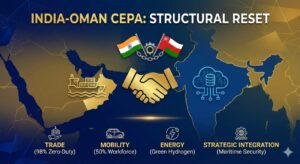
 The signing of the India–Oman Comprehensive Economic Partnership Agreement (CEPA) marks a decisive structural shift in India’s West Asia engagement. It goes beyond tariff concessions to embed labour mobility, energy security, logistics, and long-term strategic alignment into a single framework (Economic Times, Times of India, Hindustan Times, Daily Pioneer).
Signed in Muscat, the agreement has been described by the Prime Minister as a “blueprint for India–Oman’s shared future,” with its impact expected to be felt “for decades to come” (ANI / Economic Times / Daily Pioneer).
Indeed, India–Oman CEPA is a multi-layered strategic instrument aligning trade, labour, energy and maritime security into a durable geopolitical compact.
Trade Architecture: Near-Universal Market Access with Safeguards
Under CEPA, Oman will provide zero-duty access on over 98% of its tariff lines, covering 99–99.38% of India’s exports by value, making it India’s second such agreement in the Gulf after the UAE (Economic Times; Times of India; Hindustan Times). Indian exports to Oman stood at $4.1 billion in FY25, while imports were $6.6 billion, placing total bilateral trade at approximately $10.5 billion (Economic Times; Hindustan Times).
It is estimated that CEPA could deliver an additional $2 billion export boost within 1–2 years, and potentially $10 billion in the medium term, driven by improved competitiveness and access (Economic Times; Times of India).
Key Indian export beneficiaries include textiles, gems and jewellery, leather, footwear, pharmaceuticals, engineering goods, automobiles, plastics, furniture, agricultural products, marine products, and processed foods, many of which previously faced tariffs ranging from 5% to as high as 100% in Oman (Economic Times; Times of India; Hindustan Times).
India, on its part, has agreed to liberalise tariffs on 77–78% of its tariff lines, covering 94–95% of imports from Oman by value, while explicitly excluding sensitive sectors such as dairy, tea, coffee, rubber, tobacco, gold and silver bullion, jewellery, oil and gas, and several labour-intensive goods (Economic Times; Hindustan Times).
Quota-Based Protection and Strategic Selectivity
Where Indian sensitivities exist, tariff liberalisation has been structured through tariff-rate quotas (TRQs). Duty-free imports from Oman are capped at 2,000 tonnes of dates annually, 150 kilotonnes of polyethylene, and 75 kilotonnes of polypropylene, with imports beyond these limits taxed at normal rates (Economic Times; Times of India). Duty relaxations on certain petrochemicals are staggered over 5–10 years, reflecting India’s intent to protect domestic capacity amid planned industrial expansion (Economic Times).
Notably, India declined to replicate UAE-style concessions on gold, oil and gas, reinforcing a calibrated rather than concessional approach (Economic Times).
Labour Mobility: A Breakthrough for Indian Professionals
One of CEPA’s most consequential outcomes lies in labour mobility. Oman has agreed to allow Indian companies to employ up to 50% Indian nationals in their Oman-based operations—up from 20% earlier—with a legally binding standstill clause preventing dilution of this ceiling (Times of India).
This provision is particularly significant given that around 700,000 Indians work in Oman, remitting over $2 billion annually to India (Times of India). The agreement also ensures parity with any future concessions granted to SAARC nations, safeguarding India’s preferential position (Times of India).
Visa regimes have been liberalised across categories: Intra-Corporate Transferees and contractual service suppliers can now obtain visas for up to four years, independent professionals for 180 days, and business visitors for 90 days (Times of India; Hindustan Times).
Services, Standards and AYUSH Recognition
Oman has made commitments across 127 services sub-sectors, including IT, accounting, professional services, audio-visual services, R&D, education and health, addressing a large untapped market where India currently holds only 5.31% share of Oman’s $12.52-billion services imports (Hindustan Times).
For the first time in any FTA, CEPA includes comprehensive commitments on traditional medicine, opening Oman’s market to India’s AYUSH and wellness sector (Economic Times; Hindustan Times). Oman will also fast-track pharmaceutical approvals, accept global regulatory certifications, recognise halal certification, and accept India’s NPOP certification for organic products, directly addressing non-tariff barriers (Economic Times).
Energy, Logistics and Strategic Convergence
Beyond trade, the CEPA is embedded within a wider strategic framework. India and Oman agreed to pursue long-term energy arrangements, renewable energy projects, and green hydrogen and green ammonia ventures, alongside enhanced cooperation in logistics, manufacturing, critical minerals, digital technologies, food security, space cooperation and human-capital development (ANI; Daily Pioneer).
The leaders adopted a Joint Vision Document on Maritime Ties, reaffirming defence and maritime cooperation in the Indian Ocean and the safety of critical sea lanes (ANI; Daily Pioneer). Financial integration is also advancing through discussions on UPI–Omani digital payment system interoperability, RuPay card adoption, and local-currency trade (ANI).
Geopolitical Context and Trade Diversification
CEPA is explicitly positioned as part of India’s trade diversification strategy, accelerated by 50% punitive tariffs imposed by the US, prompting India to deepen engagement with West Asia, Europe and Africa (Economic Times; Times of India). Oman’s strategic location enhances India’s logistical reach into Africa and Europe, reinforcing its role as a trade and shipping hub (Economic Times).
Strategic Implications
- Trade Architecture as Strategic Insurance
CEPA functions less as a trade liberalisation tool and more as a geopolitical hedge against Western tariff volatility. - Labour Mobility as Economic Statecraft
The 50% workforce provision institutionalises Indian human capital in the Gulf rather than treating it as migrant labour. - Energy Transition Embedded in Trade Policy
Long-term green hydrogen and ammonia cooperation links climate transition with supply security. - Standards Power over Tariff Power
Recognition of halal, organic and pharma certifications reflects India’s growing influence over global compliance regimes. - Oman as Africa–Europe Gateway
CEPA quietly positions Oman as India’s logistics bridge beyond the Gulf, mirroring the UAE model. - Selective Liberalisation Signals Policy Maturity
India’s refusal to concede on gold, dairy and petrochemicals shows a shift from headline FTAs to calibrated economic sovereignty.